Thursday, 21 October 2010
Egypt: Cairo and the Pyramids
Egypt, home to arguably the World's most renowned ancient civilisation, and Cairo was my next stop from Tunis. Saying good bye to the Tunisian leg of my travels I boarded my plane in the still humid night and took off for the land famous for The Pyramids, amongst other things.
Arriving in Cairo at some ungodly hour of the morning I was instantly hit with an even warmer climate. North Africa appears to be experiencing a hotter than average Autumn that I shan't complain about. After some confusion surrounding my transfer to the hostel, which evidently wasn't there, I was left to search the streets of Downtown Cairo until 5 am in a taxi. A daunting experience in a city with an estimated population of between 16 to 20 million people (you would have thought they could be more specific these days) and with taxi drivers with no map reading skills what so ever! The only city of this size I have visited is Sao Paulo, Brazil, and I have to say that I would not want to search the streets there for a hostel at 5 am on my own. After some time (2 hours to be precise) I was safely resting in my bunk at Dina's hostel preparing myself for the experience of this vast metropolis.
Cairo is a hive of bustling activity. Thursday morning, after breakfast, I headed out into the city with a couple of people from the hostel for a stroll and a bit of sight seeing. The immediate impact of the size of Cairo is nothing compared to the intensity the city exudes when you step onto the pavements. The traffic here is relentless and the thick, blue/white, cloud of smog is almost suffocating. Stretching across the city like a blanket there is no escape from the toxic film.
As I made my way to the market area of the Islamic quarter you are immediately aware of the numerous hawkers and opportunistic locals waiting for their next victim. One unfortunate girl from our hostel was stung for 44 USD for a cup of mint tea, an incident I am sure she will look back on and regretfully shake her head about. Being smart here is the same, if not more important, than it was in Tunisia. That said there is a beautiful array of wares for sale inside the souqs.
Separated into various sections you will find the competitors sitting outside their stores on stools chatting until the ever popular tourist appears in view. Then the street or alley will come alive with calls for you to buy their merchandise. "Hello, where are you from?" is the common cry and a mere look or mumble from you will result in a sales pitch worthy of a BMW car show room.
Outside the main souq and I stumbled across a small road known locally as the factory street. A true diamond in the rough, this road was home to many small outlets of the factories making the products for the Souqs. At bargain basement prices its hard not come away with something. Tucked around the back of this street are the workshops themselves. I had the opportunity to watch furniture being hand made. From stools and chairs being nailed together to the wood being turned on lathes it's all there. Taking photos of the men at work is well received and showing them their pictures makes them smile. As I snapped the man at the lathe he invited me to try my hand (under his direct supervision of course)...it was a fascinating experience as the damp wood chips covered me from head to toe.
Spending the day walking through the streets of Cairo can be an exhausting experience and the evening saw a well deserved period of relaxation. I had organised a day to the pyramids for the following day and got my head down for the early start impending.
Friday morning came and breakfast in the hostel was a traditional Egyptian fare. Aubergine stuffed with spicy chilli, pita bread and flava beans it was a heavy breakfast but perfect to set you up for a day of wandering the ancient landmarks.
We were picked up by our driver around 8.30 am and headed off in the direction of Giza. Around Cairo there are numerous archeaolgical sites with the main ones being Giza, Sakkara and Dahshur. We would visit all three this day. Early morning on a Friday and I was struck by how empty the streets were. The weekend in Egypt is Friday and Saturday, I was informed, and being so there was no commuter traffic. Our way to the river, where we had to cross to get to Giza, was practically clear but the ever ominous smog loomed over head restricting your view of the distance.
En route to the Pyramids our driver stopped at a papyrus museum. Inside I was shown how the ancient Egyptians made the World's first paper. By stripping the outer layer off and cutting the inside of the papyrus plant stems into strips and soaking them in water for a minimum of 6 days (the longer they are soaked after this the darker the paper becomes) this releases the natural glues of the plant. They are then laid in a criss-cross fashion to bind and put in a press. Originally the Egyptians didn't have the modern, mechanical, presses used today so they used large stones, or fat women, and every 6 days they put a bigger stone (or woman) on to continue the press. This leads to an incredibly strong and flat paper which, because there are no chemical agents - all the glue is natural - the paper doesn't degrade over time.
Of course the visit to the museum wouldn't be complete without the sales pitch after the demonstration for you to buy the "authentic" papyrus scrolls.
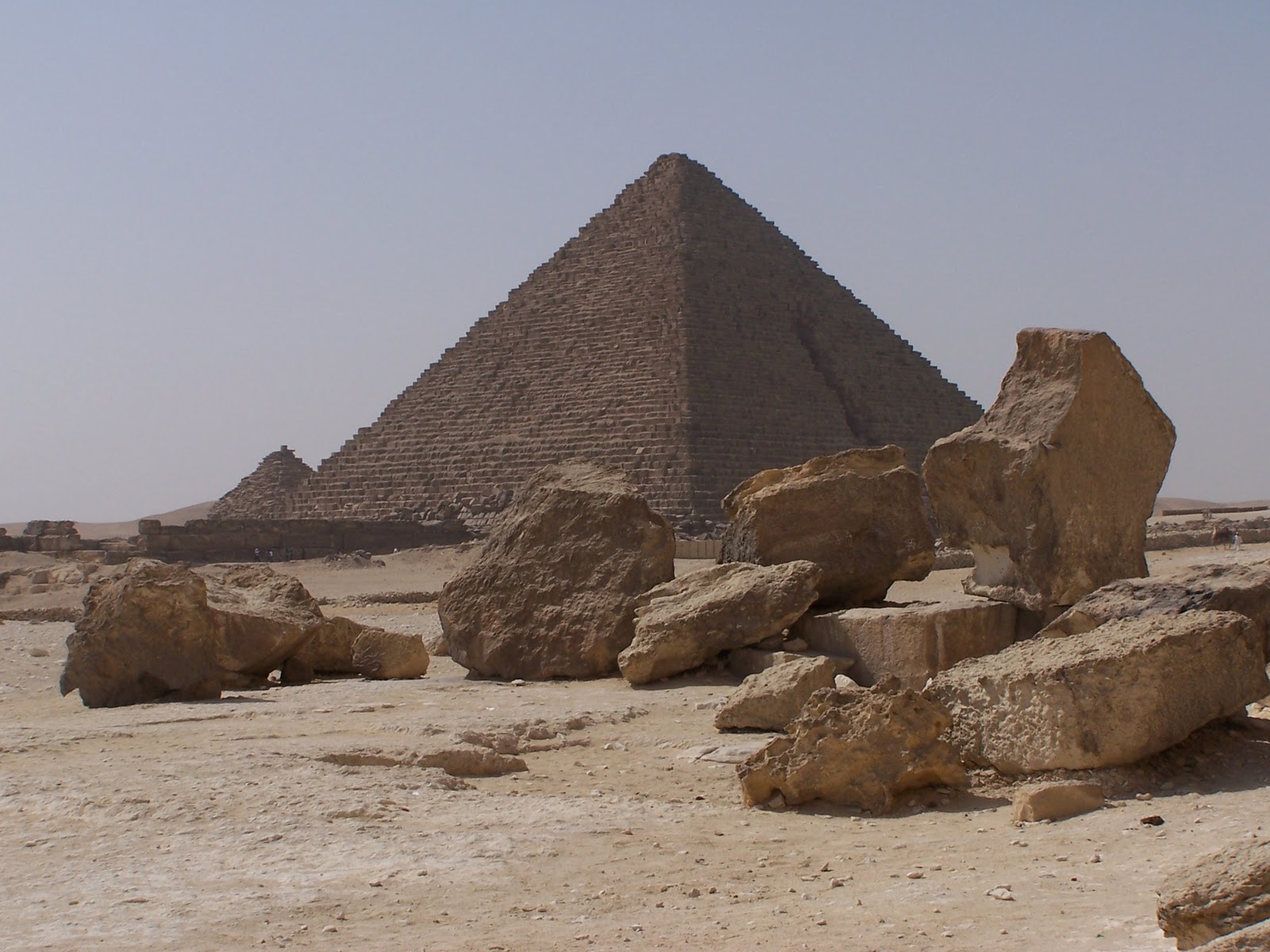
Leaving empty handed we made for the Giza location. The most famous of all the pyramids these are the three widely seen in films, documentaries and the like. Here you find the Pyramids of Khufu, Khafre and Menkaure. Khufu was the father of Khafre and built his pyramid, the largest of the three, some 4600 years ago. At 146.5 metres high it is a towering stone mausoleum crafted by artists to help Khufu's passage to heaven. His son, Khafre, constructed his own pyramid after his fathers, slightly smaller in size, however he wanted to impress power and importance and so he built it on higher ground to make it look larger. The Pyramid of Khafre is fascinating as the original lime facia can still be seen at the top of the structure. The third and smallest of these three temples was built by Menkaure and stands at around 62 metres high. Walking around the area is a truly unique experience. Since I was a child at school I have studied and learned about the pyramids and having the opportunity to finally see them has been a moment I shall never forget. Combined with the famous statue of the Sphinx it was a magnicient morning.
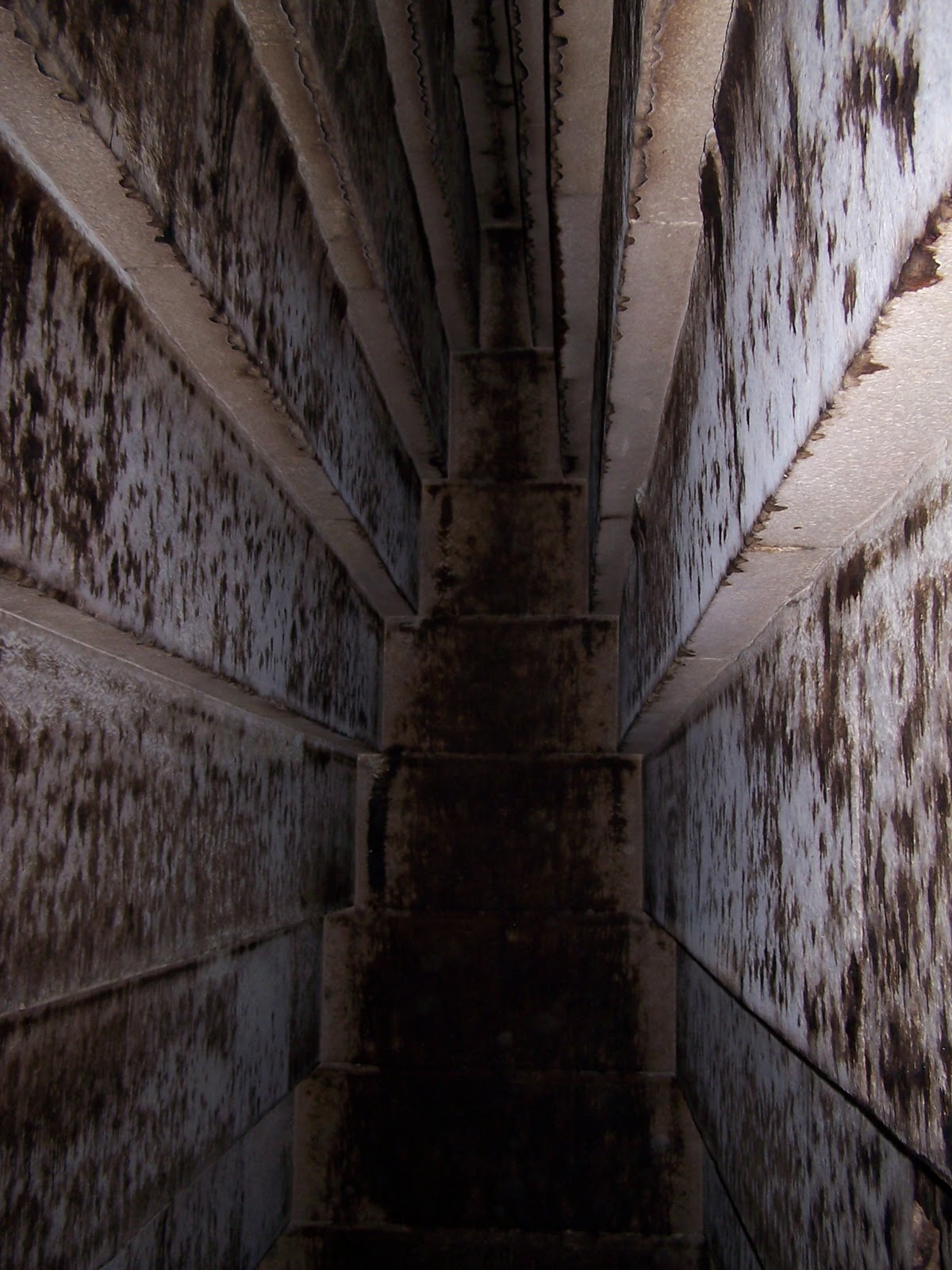
After the awe-inspiring monuments I was back in the car and heading down to Dahshur. Around 15 to 20 kilometres south from the Giza site Dahshur seemed like a strange place to go. With a few more pyramids scattered around there hardly seemed much point except that here I had the chance to enter the pyramid (although this is possible in Khafre pyramid - an extra cost). The entrance to Dahshur is a tiny square hatch in the side of the stone facade which leads into the passage. It's a steep, perhaps 45 degree, slope with battons across the floor to act as steps. Inside the air is clammy. It's a bizarre atmosphere. It feels humid as the perspiration leaks from your skin but the air is almost cool. It is great to see the inside of one of these tombs.
Seeing this much in a day can become tiring and, after an unwanted visit to an oil factory (the driver makes a percentage of anything these guys manage to sell you I found out) I headed to Sakkara. The final mausoleum stop of the day, fatigue setting in, I decide not to enter the site. The Egyptians are quite clever as they make you pay individual entrance fees for each location. This becomes expensive and feeling the strain on my wallet and my ability to absorb anymore ancient hyroglifics or stone mounments I headed back to the hostel.
To top off the most fantastic day I headed down to a local Sheesha bar with a few of the travellers from the hostel to share an apple flavoured pipe and some tea. The perfect way to pass the warm evening by. Sitting in the Downtown area of Cairo enjoying the splendid evening surround by locals all with pipe in hand is a very Egyptian night out.
The following day was all about preparing for my overnight journey to Luxor to begin my cruise down The Nile...stay tuned
Wednesday, 13 October 2010
Tunis and the North
I would like to dedicate this entry to an old family friend who recently succumb to her battle with cancer. May you rest in peace, Doreen Loveman.
Stepping off the overnight long haul train from Tozeur I was groggy and slightly worse for ware. It would seem that it's difficult to even get a little peace and quiet on a night train as a group of locals erupted in to a full blown arguement with the conductor at 1 am because he was removing someone from first class when they only had a sceond class ticket.
Shattered I was rounded up by a taxi driver and was soon flying along the main roads of Tunis towards the Medina where my hostel was. After a confrontation with the driver who tried to charge me over thirty Dinars for a five Dinar ride resulting in me agreeing to talk to the police about it - he backed off when I agreed to this and soon disappearedwith my ten Dinars that I was expecting change from - I was knocking on the door of Hostel Medina Tunis.
Lonely Planet says of Auberge Medina; "Located in a Wonderful 18th century palace in the midst of the medina, the rooms here are basic: white walls and bunk beds upstairs; comfortable but stuffy doubles downstairs. There's a pretty, tiled courtyard, the welcome is friendly and the position is priceless." This description obviously comes from a person who hasn't actually stayed there, only popped their head around the door for a look to write a piece in a guide book. It is centrally positioned in the medina making it a nightmare to walk through to the new French town around Avenue Habib Bourguiba as you are eternally stopped by merchants hawking their wares. The "hot water" is warm at best when it is that but there is a pretty courtyard. This palace plays host to some Arabic weddings, however, on a very frequent basis so if you like Arabic music blairing at full volume until three in the morning then you would love this place - they didn't even ask us to join in!
Tunis is really a blemish on the picture postcard face of Tunisia. It's a dirty city bustling during the day making it difficult to enjoy. You are hassled from all angles and must be careful with your possessions and have your faculties about you at all times. Not hard when there is not a bar or club in sight to loose said faculties in a night of frivolities.
There are, though, some beautiful areas of the capital of Tunisia not far from the town centre. A short, thirty minute, metro ride to the North East you will find the magical locations of Sidi-Bou-Said and Carthage. Sidi-Bou-Said, although quite heavily adorned with tourists, is a bougainville heaven. White buildings with beautiful, hand painted, blue window grills and door frames it is set on the peninsula hill top between Carthage and La Marsa. There are a couple of georgeous, but small, beaches to enjoy with a small marina.
Carthage is a well known city from the Roman Empire but the roots of the city date way back before the Romans to 1100 BC and the Phoenicians, the original in habitants of the area known as Phoenicia - Lebanon today. The Roman ruins, from around the second centruy BC, are still here to this day and impress a vision of grandeur with the pinnacle a towering cathedral set up upon the mount which is now a museum.
Around the valley of Carthage there are also ruins of the ampthitheatre, the old Roman villa and the Roman Gardens. They make for a nice afternoon strolling around in the sun and could easily been combined as a morning excursion with Sidi-Bou-Said in the afternoon for a delicious lunch and an afternoon on the beach.
The other major tourist attraction of Tunis is La Bardo. Four kilometres to the North West of Tunis centre is a huge Husseinite palace which is home to the largest collection of ancient mosaics from this vast continent, some of Africa's oldest, which are, for the majority, in superb condition. Floor to ceiling pictures of all sorts of historic events and dipictions the floors themselves are mostly entirely mosaics. It's an impressive collection to say the least and a must see. It also plays host to some stone carved statues that are scattered around the building in crevices and archways throughout the palace.
My day here was tarnished by one of those events that can happen to anyone, especially a lone tourist not paying enough attention. On my way back from La Bardo I took the metro. It was here I was victim to the old trade known through out the world, pickpocketing. I didn't really lose much in monetary value but the wallet was a present from the Lovemans so after learning of Doreen's passing this is sentimentally harder to take. Reporting the incident to the police only served as a waste of time as I was turned away after a two hour wait with the "We no English speak" line. Thanks for nothing!
Although Tunis is not the best city for a tourist and certainly not for the length of time I have stayed here (eight days) it has given me the chance to continue my training for my hiking later on in this African adventure. Belvedere park is around three kilometres walk from my hostel so I have been running there a lot and also had the chance to find a gym which I have frequented on a number of occasions these past days. I found myself a local little eatery, called Borchani's, where I was able to get couscous and vegetables with half a chicken and a drink for the equivalent of less than three pounds sterling, really helping my to boost my dietary protein content which up till this point has been hard to do. The Tunisian diet is heavily based on carbohydrates. Bread, couscous and potatoes the norm. I have found some local sweet delicacies called Baklava and Masfout De Tunis. Both are cheap, extremely tasty and extremely fattening! Good job I have been training then.
Whilst in Tunis I have also been on the hunt for extra adventures for later in my trip. With Kilimanjaro still the height of the travels I have also booked a trip to Mount Kenya, the second highest mountain in Africa where I will be trekking to the Lenana point. At 4800 metres it is nearly 1200 metres below the summit of the highest freestanding mountain in the world but it will serve as a great warm up and test for the main event. I am also booked on to a Masai Mara game safari. Two events I am now really looking forward to. I will also look into climbing Mount Meru, Tanzania's second highest mountain.
As I write this entry I am whiling away the remaining hours of my stay in Tunisia with Bob Dylan keeping me company. I've been here for three and a half weeks now, how time flies, and in what will seem the rapid movement of the fleshy skin covering the eye I will be sat on a plane to Egypt and Cairo. Stay tuned as I begin the second leg of this African ensemble. Below is my favourite picture from Tunisia. Something that, for me, depicts some of the uniqueness that this land offers.
Friday, 8 October 2010
Tozeur and the Desert
As you might expect travelling to the exotic reaches of the Sahara desert is not the easiest of tasks to accomplish. From my overnight stay in Matmata I set out at a reasonably early time to journey to Gabes, one of the larger cities in the southern region of Tunisia and main transport hubs. With no direct means of transport this alone took two louage journeys. Arriving, after a short walk from the local louage station, at the main louage base of this unattractive and dirty city I was informed that it would take a further three louage rides to reach my destination of Tozeur. I was at an impasse. I greatly desired to reach the depths of the Tunisia desert but I was tired of the travelling and I was having a hard time coming to grips with three more louage journeys and the sheer length of time it would take to reach my destination (ten to twelve hours). I had to make an executive decision there and then. I knew there was a train from Sfax, where I had stayed almost a week earlier on my voyage south from Sousse, to Tozeur but I didn't know the schedule. There are only two trains daily to Tozeur so I said to myself that I would take the train to Sfax and if the train to Tozeur was timetabled within a reasonable period I would make the journey otherwise I would head north to Tunis earlier than planned.
As it turned out I made the right decision. My train arrived into Sfax around 1.20 pm and the train to Tozeur departed at 1.30 pm. I was over the moon with joy at my lucky reprieve and was soon rattling along the metal tracks in an air-conditioned carriage. It was still a five hour train ride but in the grand scheme of things that was almost the blink of the eye.
The sun was setting over the golden sand dunes that surround the northern and western outskirts of Tozeur and, as I disembarked, I wound my way through the cobbled streets and alleys of this arid region. Tozeur is a smallish city located on the western frontier of Tunisia and is a sleepy town in comparison to some of the bigger cities. The buildings are mostly made from much smaller and more intricate brickwork and after dark the locals congregate in the nnumerous little cafes that line the main streets.
My hotel, Hotel Residence Karim, was situated on the main tourist drag and when I arrived I was greeted by the patron who refers to himself as Fred. A one armed Tunisian of short stature he was very welcoming. Safely nestled in my dilapidated room I then signed up for a 4x4 tour of Chebika, Tamerza and Mides for the following morning.
Chebika is a tiny little area set in the mountains some fifty kilometres outside Tozeur. A desert oasis home to an old Berber settlement it has a tiny flow of natural water, now channelled through an aqueduct, and palm trees making this one of the only areas with any vegetation for miles around. A beautiful little spot with paths into the hills it's only drawback is the vast swarms of tourists dumped by the infinite number of 4x4 tours buzzing around the desert - including myself, evidently.
Moving on and the next location of this half day excursion was a small canyon at Mides. A remote location with yet another Berber ruin set upon the peak of the canyon wall it was only one kilometre from the Algerian border. Along the route into the canyon there is the intimidating fortress of the Tunisian military, fenced off with barbed wire, nestled on a high peak. A blot on the landscape you wonder what type of atrocities this site has seen and been party too over the years.
Tamerza was a different place to visit altogether. A vast contrast of old and new I was dropped at the entrance to a modern complex. Inside the complex was a selection of refined shops and a brand new hotel. At the back of the building was a balcony overlooking the mountains behind Chebika. In the valley between stood another Berber village which looked to be in restoration. It was a bizarre sight, the modern, clean lined structure overshadowing the old relic.
Tour over and it was back to Tozeur for lunch. During the morning I had been with Tina and John, an Australian couple holidaying in Tunisia, who were staying in the same hotel. They agreed to do the afternoon 4x4 tour to Ong Jemel and the surrounding area of Nefta. Before hand they very kindly agreed to drive me out to Chott El Jerid, the desert salt lake to the south of Tozeur, in their hire car. A short journey into another region of this vast desert wilderness I was reminded of the salt flats of Bolivia as we drove through the mirage of this white expanse. With barely a sign of life anywhere other than on the main highway that cuts through the centre of this region it's a true sight to behold.
If you are bored of my talk of Star Wars locations then you can probably skip the next few paragraphs but for a geek like me and those that are interested the afternoons tour was the pinnacle of all the sets and locations I visited. Our 4x4 driver was a lunatic, haring along the beaten desert tracks at ninety kilometres an hour, he made short work of the drive to Ong Jemel. Ong Jemel translates as Camel Neck. The area is given it's name from the rock formation on top of a hill in the arse end of nowhere to the north of Tozeur. It is also the location used in A New Hope, Return of the Jedi, The Phantom Menace and Attack of the Clones. As we approached the location we could see how it earned it's name. The head and neck of a camel protrude from the hill and the lumpy section behind serves as the hump. From the base of this hill you can also imagine Luke Skywalker scanning for Artoo Detoo as you gaze across the barren terrain.
Moving on and we headed for Le Grand Dune. A golden sand expanse where you can sometimes find some of the old fibre glass bones that where made to create the carcasses of the ancient beasts in A New Hope - I didn't find any. It was here that our psycho driver made a total prat of himself though. Bouncing over dunes and pummelling his 4x4 he headed up the largest of the dunes where other 4x4's had stopped at the top to allow the tourists to have a view across the desert. His innate stupidity shone as he changed gear on the way up this dune and caused a complete loss of momentum...
We were to discover this wouldn't be the last of these occurrences!
The next spot, however, was every Fanboys dream. Mos Eisley Spaceport; Never will you find a more wretched hive of scum and villainy
You'll be glad to know that is the last of the Star Wars entries.
The final part of the tour was to head to some remote location a few kilometres to the west of Nefta, a smaller cousin of Tozeur and bereft of anything of great interest to tourists. It was a question mark in our minds why our driver had brought us here. For a great part of the afternoon we had been surrounded by other tour drivers, here there were none to be found. We had a few minutes to walk around the almost non-existant Souq before we drove out to the sand dunes to see sunset. This is where the tour began to crumble like a house of cards. Our driver had left it too late and the sun set as we made our way out - very disappointing - and just as we left the road and drove over the sandy plains our driver performed his trick of changing gear at the worst possible moment and stalled the vehicle. We knew there was a problem with the car since the earlier incident but this time we were well and truly up the proverbial creak without a paddle. The 4x4 wouldn't start and was stuck in the sand.
Have you ever had one of those moments in your life when you thought that perhaps you had got yourself into something you would struggle to get out of? Well this was it for me. We were in the middle of the desert as the sun had set and there was barely any other people around other than a few hawkers who try to sell crummy hand made dolls to tourists on the dunes and they were fast disappearing to some unknown home. We had no choice but to start walking toward the main road and see what we could do about getting back to Tozeur, roughly fifty kilometres away. As we trudged, dejectedly, towards the road we heard the roar of another 4x4 somewhere in the distance behind us. We turned to see this 4x4 stop alongside our own and then pull in behind and hook up a tow rope. A glimmer of hope. We stood and watched as any attempt to extract our vehicle failed and then the 4x4 started moving off on it's own. As it approached we wondered what would happen until it stopped alongside us and we were offered a lift in the three spare seats in the back - what are the chances! Relief! We made it back to Tozeur with no further drama and were also grateful for the partial refund we received.
The following couple of days in the desert were extremely low key. Exploring the massive palmerie, an area of the city with over 200,000 palm trees, being the high-light. Made all the better when, as I became lost in the massive grove, I was found by a local who then took me to his house, introduced me to his family - my inadequate French highlighted even more - and then drove me around the Palmerie on his moped and took me to his favourite cafe in Tozeur. Thanks Youssef!
My time in the desert and the south of Tunisia had come to an end. After four days in Tozeur I packed my bags and headed to the train station. I was extremely glad to have made it after all the troubles getting there. I climbed on board the train and settled into my seat and awaited departure for Tunis, my final stop in this North African state.
Tuesday, 5 October 2010
Tataouine to Matmata
For all you Star Wars lovers the last week has been like living a dream. Visiting locations across the south of Tunisia I have seen things from Luke Skywalkers home to the Spaceport of Mos Eisley.
Leaving the somewhat washed out island of Jerba off the South East coast of the Tunisian mainland I took a louage to Tataouine, famously known as the home planet of the Skywalker family. A louage is a local transport. Generally a multi-person vehicle taking 8 passengers. They are a cheap method of getting from A to B. They do, however, have their draw backs. Often cramped and, especially in the desert landscapes of the Sahara, can be uncomfortably hot. They also require a full compliment of commuters before they depart for their destinations. In the larger cities and to the larger destinations this is not a problem but in some of the more remote places of Tunisia this often results in long periods of hanging around for more people to arrive.
I was fortunate on this louage to be the final passenger to arrive at the station and we departed immediately and after reaching the mainland we were weaving our way into the Sahara. The terrain of the South of the country is barren to say the least. The only vegetation you see on any scale is olive groves. All across Tunisia you find these vast expanses of trees which are able to cope with the arid climate. Along the way i met a friendly Japanese fellow called Hazimee. He told me of a remote location just outside Tataouine that he was destined for and after a short while I had imposed and joined him on this excursion.
Douiret is about 20 kilometres outside Tataouine, which is really nothing more than a desert township. A tiny little village, called the modern village, is set in the valley below the mountains of the Sahara and the old Douiret is nestled in the upper extremities of the same mountains a few kilometres further into the arse end of nowhere. On top of one of the highest crests, cut into the mountain, is an ancient Berber ruin. Our louage drops us at the bottom of a set of steps that lead into the hillside and as he disappears from view I am beginning to think I have mad a bad choice as the blistering sun beats down upon us and there isn't a sign of life anywhere.
I was, therefore, incredibly relieved when at the top of the steps we were greeted by a man who owned a hotel in part of the ancient settlement. The hotel was a true find, like nowhere i have ever been before and after getting full board accommodation (there wasn't a restaurant or store for more than 25 km) Hazimee and I spent the afternoon exploring the mountainside. It's a truly remarkable feit that anyone could have lived there but the houses carved into the rock are testiment to mans ability to survive and inhabit tough terrains. The hotel, although not actually a part of the set, looked exactly like something from Star Wars.
The following morning was one of the occasions when the louage took a while, 3 hours to be precise - and only then left because I paid for the extra spaces and i was back in Tataouine and making my way to Matmata. At the louage station in Tataouine i ended up having to hire a louage privately, fortunately it was only the equivolent of 10 pounds, and was on my way to the pinnacle of the Star Wars sets - Luke Skywalkers home.
2 louages later and i was in yet another remote desert location. Matmata is really only on the tourists map because of the Sidi Driss hotel which was the famous abode in A New Hope. I stayed a night in the hotel, which in reality was not all it cracked up to be as you felt like part of the attraction as people snap pictures of the dining hall where Luke sucked down a blue milkshake and you are eating your dinner.
Remember that one of my biggest reasons for coming to Africa is to climb Kilimanjaro. I have not forgotten either and I am still training as much as I can. In the 40 degrees heat of the Matmata mountains i decided to go for a run - crazy eh? Well, perhaps, but perhaps not as a i hit the highest peak, around 1000 metres altitude, some four or five kilometres out of town i was rewarded with stunning views right across the desert plains all the way to the sea. It was something quite unique. The looks I got from the locals driving along the deserted hilltop road were also worth the effort.
In my next update you'll get to see vast desert landscapes, more Star Wars locations and the final leg of Tunisia, Tunis and the Northern territories. TTFN
Subscribe to:
Posts (Atom)