Friday, 12 November 2010
Kenya: Masai Mara
From the scorched desert lands of the ancient Egyptians I found myself landing in the, somewhat damp, Kenyan capital, Nairobi. It's the time of the short rains and as I was collected from the airport by my tour company and whisked to their office I got my first taste of East Africa. The outskirts of Nairobi being a lush green landscape the roads were a lot more like the busy streets of London with the lunchtime traffic bustling around, the difference being the chaotic swerving and jostling to squeeze through non-existant gaps with vehicles spewing black smoke from their exhausts.
On arrival at Sana Highlands Treks and Expeditions headquarters I met Huldah, the girl I have conversed with on email for the past month, and was informed that my group for the Masai Mara safari had all fallen ill. The only option I had was to go on a two night excursion, missing out on Lake Nakura, but still leave as planned the following morning. Dejectedly I agree to the change with the only upside of saving a day's safari costs and the company paying for a nights accomodation in Nairobi.
At 8.30 am the following day I was collected from the Milimani Backpackers hostel by Ojanjo, my driver for the safari and next 3 days, and was taken to meet my fellow tourists. During the next two nights Edmund and Regita, a German couple holidaying in Kenya, would be my companions.
The Masai Mara is a long drive, West, of Nairobi. We left the crowded and congested capital and headed towards the Rift Valley that we had to cross to reach the famed Kenya game reserve. Along the way I got more of a taste of the Kenyan way of life. On the sides of the roads women, baring large loads of wood supported only by a strap over the top of their heads, walked barefoot on the dirt and stone streets. Locals crowded around little, corrugated metal, kiosks selling various consumerables. Kenya is a place of logos and on every building, billboard, or any other walled surface there huge corporate emblems, "Nescafe for only 5 Shillings a cup" to mention but one.
Before long we were passing though a dense forest along the crest of a hill and the road bent round onto the side of the Rift Valley. A vast basin spread across my view and on the other side was the dormant volcanic beast of Longonot. We stopped for the obligatory photos of this impressive landscape. On the side of the winding valley road were a couple of Curios - little kiosks selling hand carved, wooden, imitations of the game animals we hoped to see. The vendors were quick to pounce and deliver their well rehersed sales pitches.
After a lunch stop in a rather suspect transit motel we left the tarmac of the main road and diverted onto a heavily potholed track that left the buttocks rather bruised from the constant bouncing for two hours to the lodge. Ojanjo did his best to avoid the gapping wells in the surface but you'd have needed a hover craft to have had a comfortable ride.
The Mara Hippo Safari Lodge would be my dwellings for the next two nights. Set by the entrance to the game reserve the campsite, one of the countless dotted around the plains of the safari park, consisted of wooden canopies that sheltered large, green, tents. A restaurant and pool (that looked like elephants had been washing the mud off themselves in) completed the grounds. At night animals often wander through the complex as there are no fences from the game reserve so security is employed to try and ward them off - men with big sticks and a head torch!
Our game drive scheduled for the afternoon of our arrival was cancelled due to torrential rains so we started out the following morning earlier than normal. We'd had breakfast and a lunch was packed so we were set for a full days game driving. In our white toyota minivan that had been purposefully converted for driving across the Mara we entered through the gates and we were immediately presented with photo opportunities.
According to Ojanjo many of the non-predatory animals shelter near the human camps at night as they feel safer from carnivorous beasts that roam the huge reserve. Zebra, Buffalo, Antelope and Gizelle alike were all strolling out onto the plains to graze.
To describe the whole day is virtually an impossible task. The information Ojanjo told us as we wound our way across the Mara and spotted the various different creatures in their natural habitat was immense. To pick some of the highlights I have to say that the lions basking in the sun, the elephants plundering along vast plains, the cheetahs - that had just hunted and killed a gizelle and were devouring it - and the leopards casually strolling the banks of the stream or resting in the branches of a tree were the sights that will forever stick in my memory.
A full day's game drive is a long experience though. At times I was caught napping in the van and was given a friendly poke by my German companions to arouse me and let me catch sight of more of the fantastic creatures roaming the reserve.
The Masai Mara is home to the Masaai tribe and is also the northern conjoint twin of Tanzania's Serengeti. They are one and the same game reserve and the only real division is the line on a map that has been greatly disputed by the tribes of the different countries. It is an enormous expanse of rolling green plains and hills and to see so many of the so called big five (elephants, lions, leopards, buffalo and rhinos) was a real treat. Leopards are a particularly rare treat and to have seen two different ones in the same afternoon was incredible. Unfortauntely the rhinos remained elusive to us this day. Not often found in the Masai Mara they are more commonly found at Lake Nakuru - the location I was missing out on due to the change in my expedition.
As the day was drawing to an end we bounced our way along the muddy tracks cut into the the ground by the countless four wheel drives and white safari vans. We'd had a glorious day of sun with hardly any clouds in the sky and as we neared the gates to the reserve we were graced with an astounding sunset to crown the day. Over the rolling hills, to the west, the sky was a beautiful purple and amber as the sun beamed through the growing clouds. It was the perfect end to a truly memorable day.
The following day, our last in the Mara saw us up early for a pre-breakfast game drive. Mainly for people to try and get some pictures of the animals they had not yet captured the main attraction of the morning seemed to be the pride of male lions resting on a large rock. The safari vans were gathered in the their masses around them and the vehicles all seemed to block each other into a group. It was still low season but there seemed to be ample amounts of gawking tourists taking pictures with varying degrees of photographic equipment.
We headed back to the camp, had breakfast and checked out of the accommodation and then headed for a visit to the Masaai people's village. A short distance from the camp we were greeted by one of the chief's sons. We were introduced and then given a guided tour of the wooden huts with manure covered walls. We were told about their lives as the inhabitants of the area. The people are ranchers with a large head of cattle and goats. The village in which they reside is also the play pen for the animals and the ground was totally swathed in cow and goat droppings.
The Masaai people vary in the modern age. The notable large holes in the ears from heavy rings are not unanimous anymore. The younger generations are a mix of people with normal ears and the low hung hoops. Those with normal ears are the ones that have attended school. They are a people who are gradually becoming slightly more westernised. This said the chief's son, someone who had been schooled, had still proven his manhood by killing a lion in close combat with nothing but a spear and a hunting knife. He showed us his crown made from the lions mane and also allowed me to be photographed wearing it.
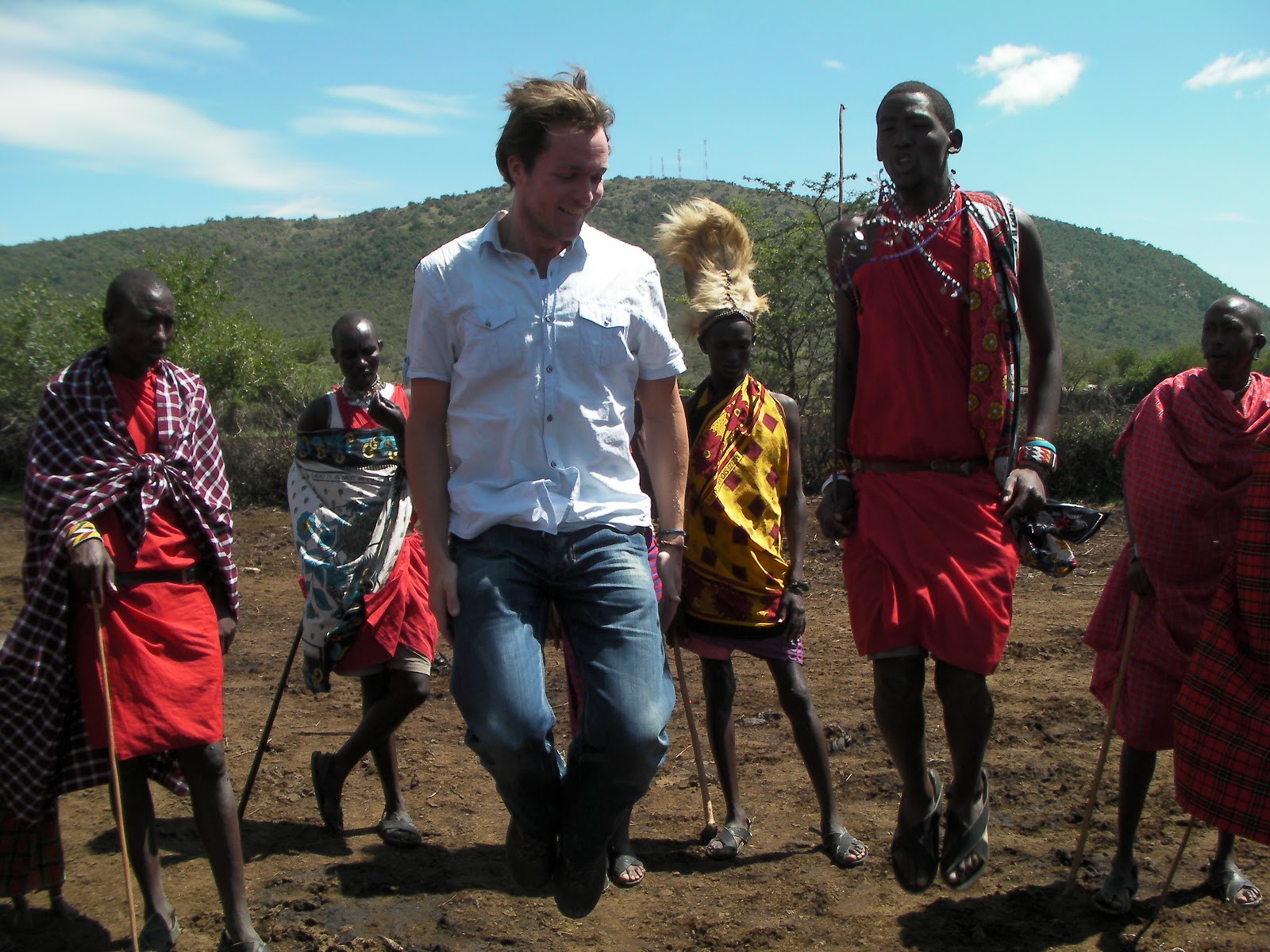
We were then treated to two different songs and dances. The first by the women. A welcoming song which was followed by a parade and another song of blessing. We were told that the women with metal braclets on their ankles were married and that the leather belts some wore around the midsection symbolised they were mothers. Next we were given a demonstration of the male dance and song. This dance was more of a jumping competition that was to prove how strong you were. The higher you could jump signified that you were stronger and that to marry you would have to pay for less cows. Paying for cows is the traditional fee for marriage. The standard price is ten cows but if you are a strong jumper you would pay for less. I had a go jumping with the chief and I was told I would pay less than ten cows, he didn't tell me how many though.
We were then shown how they make fire by using a hard wood spindle in a soft wood block and kindling. A technique that has been passed down through the ages. We were taken to the chief's son's home and here he showed us the tooth of the lion he had killed and made into a necklace. The spear he used to kill the lion was presented to us and after a demonstration of how to use the projectile weapon we attempted a throw ourselves - I was less than deadly. As we were shown to the stools were they sell hand made souvenirs and gifts I was taken aside and asked if I wanted to buy an extra-special souvenir - one of the teeth from the lion. It was an honour not bestowed on many people. It came at a price, but then what price can you put on the tooth of a ferociously savage and wild beast that was slain at the hands of a Masai chief?
As we said goodbye to the Masaai people I was faced with the arduous return journey. As soon as the experience had begun it had ended. Like so many of the special adventures you get to experience when travelling this one had passed with a rapidity that was, at times, bewildering. I would have only a few short hours back in Nairobi to prepare for the next adventure the very next morning...Mount Kenya
Tuesday, 2 November 2010
Dahab and Mount Sinai
Nubian, Bedouin, use which ever Arabian word you like to describe Dahab as they are both felicitous to this relaxed resort.
Set on the east coast of the Sinai peninsula on the Red Sea over looking the rocky hills of Saudi Arabia, across the waters Moses supposedly parted, it is an indubitable paradise. Along the water front promenade there are chilled, cushioin adorned, lounge bars welcoming you to enjoy the sea view, the sun or the starry night sky, tuck into some fresh red snapper prepared on a barbeque grill or smoke the famous Sheesha pipe so symbolic of the Arabian nations.
Arriving from Cairo this small town was a breathe of fresh air, quite literally as the smoggy air of the Egyptian capital was left far behind and replaced with that familiar salty sea breeze. My home for the next week would be the Penguin Hotel and Dive School. Situated on the front the Penguin restaurant is one of the lounge bars with an upper deck built from wood and palm trees graced by the sun all day long. Along the coast and in the bays around Dahab city there are numerous spots where kitesurfers and windsurfers take advantage of the strong winds that are prevailent here. Without the wind the town would melt in the scorching heat which, even in late October, is simply fierce.
Having not dived before I had hoped to do my PADI here. Unfortunately being a traveller on a budget sometimes means that you can't always do everything (I didn't say that in New Zealand though) and having spent a large portion of my Egypt budget on a luxurious Nile cruise this was the activity that had to fall by the wayside. It's something that will have to wait for the South East Asian beaches another time.
As a large portion of people come to Dahab for the diving this meant that the town during the day was relatively empty and I took advantage of having the pick of locations to relax in the sun. In the later afternoons as the sun was setting over the hills behind Dahab, to the west, I continued to train for the now looming hikes of Mount Kenya and Mount Kilimanjaro. Running in the desert heat with the dry, dusty, air is no easy accomplishment but I fought the climate and nature (the strong winds being a real pain) and continued to run day after day.
Another of the main attractions around Dahab is Mountain Sinai and St Katherines. Famed as the location where Moses climbed to the peak of a hill and received the Ten Commandments it is a tourist attraction that really can't be missed. The Sinai peninsula has been the subject of controversy throughout the ages. Egypt and Israel have long debated it's true ownership.
From Dahab you have the option of doing either a sunset or a sunrise expedition. I chose the sunrise one meaning I was picked up from the hotel at 11 pm. Crammed into a tiny minibus, with my legs almost piercing the back of the seat in front, my plan of stealing a few hours sleep on the ride there was soon scuppered. We arrived at Mount Sinai early in the morning, circa 2 am, and after our aggressive sounding guide was assigned to us and we had queued and passed through the metal detector (I know, on a mountain right?!) we began the hike to the peak. In the dead of night the full moon was all the light we needed as we stumbled along the camel path.
The top of Mount Sinai can be reached by one of two routes. The camel path which winds it's way gradually through the hills till it reaches the bottom of the final stairs or the Steps of Repentance. The Steps of Repentance are said to have been laid by a monk. The 3700 roughly hewn stone notches climb steadily through the rocky mountain to the top of Jebel Musa (Mountian of Moses in Arabic). After 3000 steps the camel path meets the staircase where everyone must ascend the final 700 steps to summit the 2300 metre high peak.
It's not a taxing hike compared to many I have surmounted and our guide made sure there was no hurry in reaching the top as we paused frequently for breaks in little huts that sold everything from water to Mars Bars. The occasional "We sell Starbucks Coffee" sign was a humerous reminder of the world we live in.
Reaching the summit at around 5.30 am the distant eastern sky was just starting to lighten with the ensuing sun. Nestled on the peak I had had to rent a blanket to cower under as the cold night and dawn reminded me that at elevated levels a t-shirt and shorts was not my most sensible decision. The sun broke the horizon around 6 am. A magnificent sight as the orange light glided across the surrounding valley and the peaks of other mountains around. It was a spectacular view.
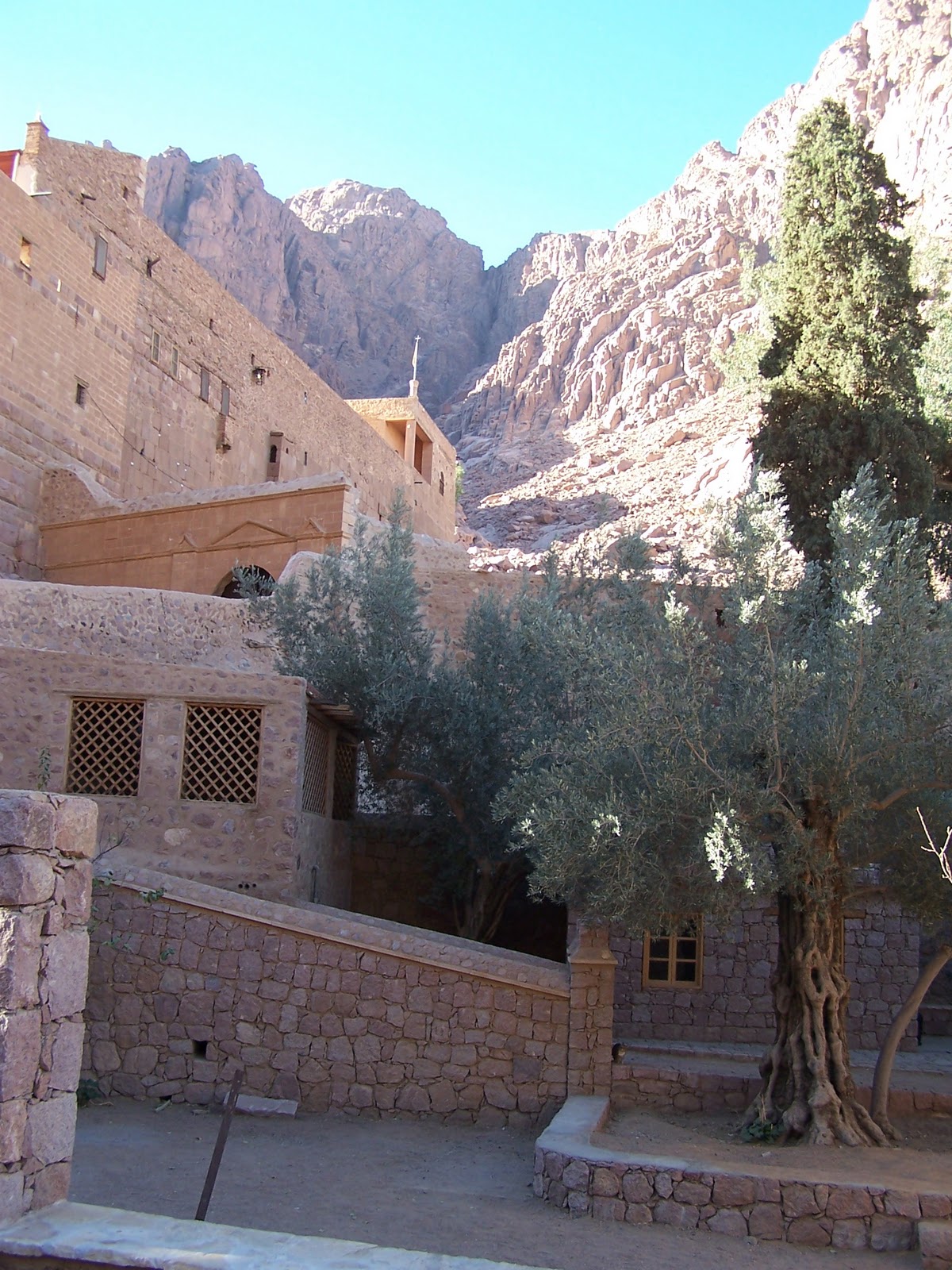
The Steps of Repentence are not the best way to scale Mount Sinai during the night but in day light they were the best route down. Far quicker and direct they do take their toll on the legs after a while but the views of St Katherines Monastery on the way down are not to be missed. The monastery itself is home to the burning bush of Moses and also houses one of the finest collection of manuscripts in the world (second only to the Vatican). German scholar Friedrich von Tischendorf, in 1844, discovered one of the oldest and original copies of the bible here, called Codex Sinaiticus.
Reaching the bottom at around 7 am it would be sometime before the 9 am burning bush section of the monastery would open so I relaxed outside the walled entrance...and fell asleep...I awoke and rushed back to the minibus for the departure back to Dahab.
Back in Dahab and I spent the rest of my time lazing around in the sun. I treated myself to a whole red snapper with vegetables and rice. Eating the delicious, fresh caught, fish I was soon joined by the familiar company of the hungry stray cats all staring bog eyed at the fish on my plate. It is very easy to loose track of time in this Bedouin resort. Soon enough my week was almost over and I began to cast my thoughts over the impending departure from the land of the ancient Pharoahs. Within a matter of days I will be boarding my plane and leaving the northern coast of Africa to head to the sub-saharan regions of Kenya and Tanzania. A place completely new to me. An area of the world I have never ventured to and with the Masai Mara to kick start the next leg of my Africa adventure I am excited with anticpation.
Friday, 29 October 2010
Cruising the Nile
Arriving at Cairo's Giza train station for my overnight sleeper train to Luxor I thought I had stepped back to a period when the railway system was just developing into a modern method of transportation. The small, old, station building with it's peeling paint and wooden windows felt dated apart from the metal detector at the entrance. Porters strolled the platform old with luggage sack trolleys loaded with bags whilst waiting passengers, both local and tourist, passed the time until the train arrived. The train was almost on time and as I nestled into my sleeper compartment, joined by a fellow from Manchester, I began to anticapte the much famed Nile and the delights that I could expect.
The train pulled in to Luxor station around 7 am and I was met by my tour guide. I was taken by minibus through the early sun soaked streets of the East Bank town of Luxor. The renowned site of the Greek named Thebes, the ancient Egyptians home to the impressive Karnak and Luxor temples.
HS Aton, a large Nile cruiser vessel, was to be my home for the next three nights and as I checked in I was lead to the Nile deck (the bottom deck) and shown to my room. The Nile cruises are known for their luxurious settings and accommodation and I was very pleased, as I walked into my suite, to find a king size bed, en-suite and the usual creature comforts you'd expect in a decent hotel room. Perhaps a little unsettling I noticed that my room was half below the water level with only the windows above the mirky surface.
Comprised of five decks the boat was a veritable floating hotel. With four decks of compartments, a buffet restaurant, the Cheers Bar and an upper sun deck with it's very own miniture swimming pool I was in paradise as the burning sun rose and showered the sun loungers. I took it upon myself to test the sturdiness of the reclining chairs.
The buffet cart was a reasonable fare, far better than the food I had been coming accustomed to in Cairo, and later in the day I was met in reception by Mustafa, my guide, to go to the Karnak and Luxor temples. We picked up some other tourists from other hotels on the way and soon we arrived at the monsterous site of Karnak.
Karnak is probably the largest historical site in Egypt, perhaps with the exception of Valley of the Kings on the West Bank of Luxor, and is comprised of temples, chapels, pylons and a sacred lake. Devoted to the sun god, Amun Re, the centre piece of Karnak is the Great Temple of Amen. Begun by Pharoah Ramses II nearly 3500 years ago it is a huge structure with 134 towering Lotus pillars. The centre 12 form the main corridor of the Great Hippostyle Hall. As you enter through the hierglyphic inscribed walls, guarded by numerous stone statues of lion bodies adorned with human heads and their Phaorah head pieces, you catch a glance at the back of the temple, to the east, and the towering oblelisks jutting out of the ruins.
A short distance from Egypts second most visited tourist attraction (next to the Giza Pyramids) is the Luxor Temple. Another relic of the ancient civilisation it was largely constructed by Pharoah Amenhotep and added to over time. Still being uncovered is the Avenue of Sphinxes. Now believed to link the two temples together the avenue is lined by over 700 statues of the lions with human heads, the same as those that guard Karnak. In the 13th century AD muslims added a mosque to an inner courtyard of the temple. I chose not to enter the Luxor temple as it was still very hot and I was tired but I managed to get a few pictures from outside.
Even as the sun was setting in the late afternoon the temperature was still well into the high thirties and it was time to return to the boat for dinner. The night before, waiting for the train, I had met an American fellow, Larry, heading for Luxor also. We had been in separate carriages on the train but as I entered the dining saloon I saw him at a table. On a ship that was predominently occupied by large groups of French, German and Russian groups it was nice to have someone to share a meal with, something we continued to do for the next few days.
The next day was a very early start, the boat was still moored outside the Sheraton hotel and would be until early afternoon when it was to set sail up river towards Aswan. 6.45 am and the phone in my room buzzed loudly, waking me, with my early morning wake up call. After the buffet breakfast I was again greeted by Mustafa in reception and left to do the West Bank tour. I had been told the boat would leave at 1 pm. The morning of the West Bank tour did not go so smoothly. Collecting a larger number of fellow tourists it took sometime before we were all packed into the minibus and on the way to the Valley of the Kings, the first stop of the day.
The West Bank is home to the vast valley of the dead, the Necropolis of Thebes, where the limestone hills on the Nile encase the tombs of numerous ancient Pharoahs, perhaps the most famous being Tutankhamen - discovered in 1922 by English Archeaologist Howard Carter. The vast complex houses countless resting places of dead Pharoahs who were buried with treasures and riches that were to be pillaged before the last Pharoahs were even buried. So far only Tutenkhamen's tomb has been discovered untouched. Astonishingly the tombs of these ancient rulers seemed to be unmapped as, during the construction of various other tombs, the burial chambers of other rulers were sometimes encroached upon meaning that tunnels into the new tombs had to be diverted. We weren't allowed cameras inside this complex as the flash photography degrades the coloured hieroglyphics painted on the walls.
Most of the tomb's entrances are sealed to the public either for conservation or restoration work but we did have the opportunity to enter three different shrines. Among the great rulers whose tombs these were dedicated to are the illustrious Tuthmosis I, considered one of the more important Pharoahs who pushed the borders of Egypt further than anyone before going deep into Nubia, and Ramses II, who followed around 300 years after Tuthmoses and is also known as Ozymandias in Greek. The tunnels into the chambers buried in the limestone mountains were impeccibly decorated with hieroglyphics and art work worshipping the sun god and depicting the mummification process and the boat of the dead.
Leaving the Valley of the Kings our next destination was the Valley of the Queens, although not before the customary stop at the tour guides friends alabasta shop. Time was pressing, it was already approaching midday and we were told that the alabasta visit would last fifteen minutes. We were given a short demonstration of the methods employed for making the fine alabasta vases and the other works they did. They told us about the granite, floated down the Nile from Aswan, used to make figurines and busts, the real, glow-in-the-dark, statues and some other statues that left little to the imagination as to what they thought of their endowments.
Nearly an hour later after several of the other members of the group had spent a long time haggling over prices for the souvenirs whilst the rest of us had to wait in the hot, arid, heat we headed off. I was not going to be late in getting back to the boat and I was now concerned for time. I was also becoming weary of temples, mausoleums, tombs and the like. Egypt is certainly bequeathed with it's fair share of them, perhaps more concentrated than any other place I have ever travelled and they are also astute in that they charge you a separate entrance fee for every single one of them. This becomes increasingly frustrating for the traveller on a budget. The Nile cruise as not cheap to begin with, certainly in travellers terms, being more than a weeks budget and the constant dipping into the pocket for entrance fees was becoming a real financial pain. I told the guide I wouldn't be going into the next temples and that I needed to return to my boat ready for departure. This caused a bit of an upset as I believe the tour guides get a cut of the entrance fees for the groups they bring in. The day before I had heard that Karnak temple brings in around 126,000 USD everyday of the year in entrance fees for the government. I was not going to worry about my lack of desire to enter this one in that case.
After some discussion, phone calls to head office and some aggressive sounding conversations I was being driven back to the boat with an American couple who, likewise, were getting a bit exhausted from all the tourist activities and the costs. It was also lunchtime on the boat and I was hungry and didn't want to miss one of the meals that was included as part of my cruise. In the afternoon I had free time. No more sites to visit and as I laid on the sundeck soaking up the sun's rays the boat left it's mooring and we began the voyage up river towards Aswan.
The following day I had yet another early wake up call for breakfast and to prepare for a visit to, you guessed it, another temple. The boat had arrived overnight at a place called Edfu. Still feeling the effects of all the tourist bashing I elected to forgo this temple and instead headed up to the sundeck. It appeared as though the entire ships compliment had gone to the historical site so I had pick of the loungers at about 7.30 am and I remained in that spot, turning myself routinely like a rotisserie chicken, until lunch. The boat had departed late morning to head to Kom Ombo, another location enroute to Aswan. The Kom Ombo temple was easily visable from the boat as we approached and again I elected to forgo entrance as I took pictures from the top deck. As the boat moored there were local children skimming stones into the Nile. They were obviously waiting for the next boat load of unsuspecting tourists as we were soon proffered braclets and other hand made sellables. As the the day drew to an end I caught my first sunset on the Nile. The boat was moored heading due south and I had a perfect panorama from our east bank position looking across the river and palm tree lined western bank.
The final part of the Nile adventure included a bus ride to the southern most region of Egypt approaching the border of Sudan. In the evening and overnight the boat set sail for Aswan, our final mooring location, and from there I would take the bus to Abu Simbel to see the much revered Great Temple of Ramses II. In the evening I was informed that my wake up call would be at 2.45 am! Buses and coaches must travel in police escorted convey across the southern desert and because of the distance and the need to return the same day for people to catch the return train to Cairo it must be an early start. I was wondering if this was going to be a worthwhile escapade.
2.45 am and the same, loud, buzzing phone woke me up and after receiving my cardboard boxed breakfast we were lead to our minibus and went to the convoy area. The bus was cramped and full and as we set off at 4 am I was waiting for the sun to rise to make things just a little more uncomfortable. It was a three and a half hour drive to Abu Simbel and we were given an hour and a bit to explore the temples before we had to undertake the return journey.
The Great Temple of Ramses II was perhaps the most exquist example of ancient Egyptian glorification. Two massive temples with imposing stone statues of Pharoahs guarded the entrance like colossal warriors. Inside the atmosphere was close, humid and sweaty but the art work on the walls were incredibly detailed and well maintained. It was worth the effort to come and see these monuments that had twice been moved after the Aswan dam had been constructed and flooded the Aswan to Abu Simbel Valley. The only downside was the no photography rule inside the monuments.
Bus ride back to Aswan and then it was time to head to the train station and catch my overnight long haul back to Cairo. Just as soon as the trip had begun it felt like it was ending. The train departed the platform at 4 pm and I was left contemplating the remarkable sights I had seen and experienced the past few days in my sleeper compartment that I had to myself. From the vast and enchanting relics of a civilisation once the pinnacle of the world to the cows that appeared stranded on small islands in the middle of the river it had been one of the those trips that is inscribed in your memory forever.
I had a few days in Cairo to pass before I headed to Dahab, on the Red Sea coast, and Sinai where I would visit St Katherines and Mount Sinai, my final stop in Egypt...
Subscribe to:
Posts (Atom)